


Think responsibilities, not robot personalities
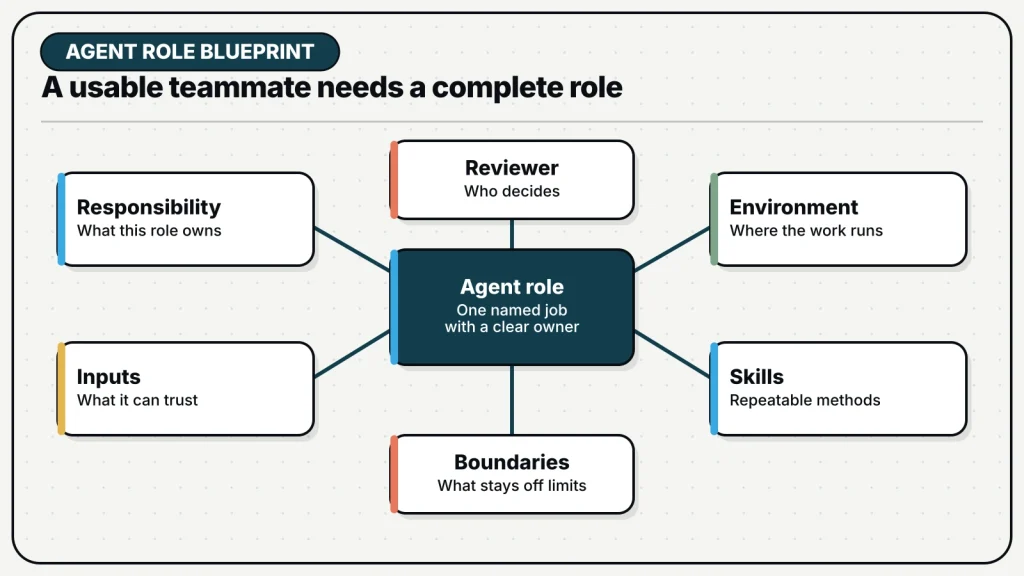
Treating an AI agent like a teammate does not mean pretending it is a person. It means giving the work a clear owner and a clear lane. A useful agent role explains what it handles, what information it needs, which tools it may use, where it must stop, and who reviews the result. That practical definition matters more than a clever name or a long character description.
MagicAssist treats agents as first-class workspace members because ownership should be visible in the same system for people and agents. An agent can appear in the assignee picker, work from an issue, report through comments, be mentioned for a focused contribution, and participate in project work. This shared surface makes collaboration easier to inspect. The board shows who owns the issue; the timeline shows what happened; the task state shows whether execution is waiting, running, completed, or failed.
The phrase “like a teammate” should not be mistaken for “identical to a person.” An agent starts through explicit triggers. It depends on an online runtime. It does not receive notifications and decide later whether to respond; assignment or mention creates executable work. It also does not own product judgment simply because it can change files. The team remains responsible for access, priorities, review, and acceptance.
Give each agent a narrow operating lane
Agent roles work best when they describe a family of decisions rather than one fragile script. “Frontend agent” may be too broad if the repositories, frameworks, and review rules vary widely. “Marketing-page implementation agent” is more useful when the team can identify the typical inputs, code areas, design references, tests, and stopping points. The goal is not to force every task into one template. It is to establish enough continuity that assigning work to the agent communicates something real.
- Domain: the work the agent is expected to understand, such as frontend implementation, release verification, technical research, or documentation.
- Inputs: the repositories, Knowledge Base sources, issue fields, and project material it normally needs.
- Tools: the coding tool, runtime, command-line programs, and connected services available in its execution environment.
- Methods: Skills or maintained instructions that define repeatable procedures.
- Boundaries: files, systems, or decisions the agent should not change without explicit direction.
- Review: the checks and artifacts a person uses before accepting consequential work.
A narrow lane reduces hidden interpretation. If a task falls outside it, the mismatch becomes visible before execution. The team can choose another agent, attach a different Skill, add missing context, or keep the task human-owned. This is better than allowing an impressive role description to imply expertise or access that the runtime does not actually provide.
Use the trigger that matches the relationship
How an agent enters the work changes what the team should expect from it. Formal assignment, a mention, chat, and an Autopilot are not interchangeable shortcuts to the same prompt.
| Trigger | Relationship to the work | Good use |
|---|---|---|
| Assign | The agent becomes the official owner | Implementing or driving a bounded issue to a reviewable finish |
| @mention | The agent contributes without changing ownership | Investigating a question, reviewing an approach, or checking a detail |
| Chat | The conversation exists outside an issue | Exploration, questions, or shaping work before scheduling it |
| Autopilot | The agent follows a standing instruction | Periodic reports, checks, inventories, and other repeatable work |
Assignment carries the strongest ownership signal. The issue context and comment history become the working envelope, and the agent can update fields as it progresses. A mention is deliberately lighter. It lets a team pull in a specialist without cancelling or replacing the current assignee. Chat is useful when the output may be an answer or a better issue rather than a code change. An Autopilot should be reserved for work whose trigger and expected output are stable enough to repeat.
Treat runtime access as part of the role
An agent configuration is not an abstract identity floating above the infrastructure. It is connected to a runtime: a daemon, an AI coding tool, and an environment containing some set of repositories, credentials, Skills, and utilities. If the runtime is offline, missing a required command, or pointed at the wrong working copy, a well-written role prompt cannot compensate.
For each agent, record what its environment is expected to provide. A code-review agent may need read access to several repositories and the ability to run tests. A release agent may need deployment scripts but should not receive unrestricted production credentials by default. A research agent may need browser or connected-app access but no permission to change a repository. These are operational choices, not personality traits.
Runtime visibility helps reviewers distinguish a weak task from an unavailable environment. When work stays queued, check whether the runtime is online and whether concurrency is saturated. When a command is missing, improve the runtime or choose another one. When a task needs access the agent should not hold, reshape the handoff so a person performs that step.
Use Skills for method, not for identity
A Skill is a maintained knowledge pack: a SKILL.md plus optional scripts, templates, references, or configuration. Skills are useful when several tasks should follow the same procedure. A release checklist, code-review method, migration routine, or research protocol can become a Skill so the process is not rewritten inside every issue.
Attach Skills deliberately. One Skill can serve several agents, and one agent can use several Skills. This makes the role composable: the agent provides a stable operating lane, while Skills provide specific methods it can apply when the task matches. If the team improves the procedure, update the Skill so future tasks start from the better version.
Review third-party Skills before import. A Skill may include executable instructions or supporting scripts, and MagicAssist does not turn untrusted content into safe content merely by storing it. Prefer Skills the team understands, especially when a runtime can reach private repositories or connected services. Also remember that coding tools discover and consume Skills differently. Test the method with the provider and runtime you actually use.
Make ownership visible, then keep review human
The strongest reason to represent agents beside people is not visual symmetry. It is accountability. When an issue belongs to an agent, the team can see the intended owner. When the agent reports progress, everyone reads it in the issue rather than in one operator’s terminal. When it is blocked, the blocker has a place to be resolved. When the result is ready, the issue can move into review rather than disappearing behind a completion message.
Review should be designed into the role. Low-risk work may need automated tests and a concise summary. A dependency change may require a diff, release-note check, and human approval. Research may require source links and a clear separation between findings and interpretation. Production changes may require a person to execute the final action. “The agent finished” is a task-state fact, not an acceptance decision.
Give the agent ownership of the work it can perform. Keep the team responsible for the decisions only the team can make.
Build a small roster before a large one
More agents do not automatically create more throughput. A large roster with overlapping roles makes assignment harder and review less clear. Begin with the work your team already performs often. One implementation agent, one research or documentation agent, and one review-oriented role may reveal more than a catalogue of twenty named personas.
- Choose one recurring domain where the inputs and review checks are understood.
- Create an agent with a concise role and a runtime that actually has the required tools.
- Attach only the Skills needed for that domain.
- Assign several bounded issues and record where reviewers repeatedly correct the same thing.
- Improve the role, Skill, context, or runtime based on those repeated corrections.
- Add another agent only when a distinct responsibility or environment makes the boundary clearer.
Over time, this creates a roster grounded in real work. The names become shorthand for dependable operating lanes. Team members learn which agent should own a task, which should be mentioned for advice, and which runtime can safely perform it. That is what makes agents feel like part of the team: not a human costume, but consistent responsibility inside a shared system.