


Start with a useful job, not a grand title
The best first role for an AI agent is usually ordinary. It has a clear input, a visible output, and a person who knows how to judge it. Small teams already have many tasks like this. Notes need organizing. Research needs comparing. Drafts need a first pass. Projects need summaries. Software changes need checks. These jobs can save attention without handing over the final decision.
The ten examples below are starting points, not fixed job descriptions. Choose one that already happens on your team. Run it manually first. Notice which information the agent needed and which corrections the reviewer made. Then improve the task. A reliable small job is more valuable than a broad role that nobody can review with confidence.
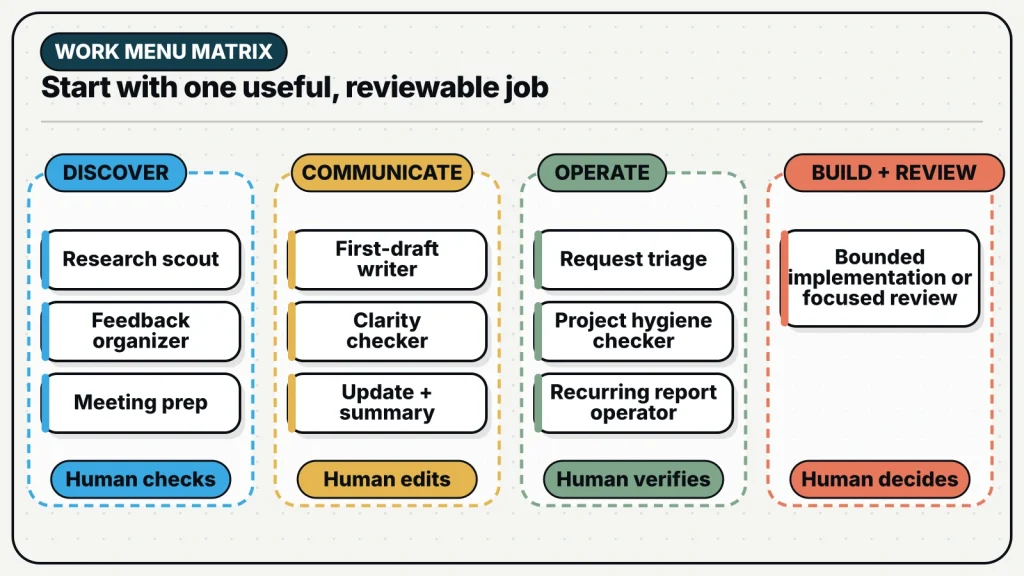
Research and sense-making
1. Research scout
Ask an agent to compare a short list of products, policies, partners, or market questions. Give it the decision you are preparing, the sources it may use, and a date range. The output should separate facts, interpretations, and open questions. Require links or citations. The agent gathers and organizes evidence. A person still decides what the evidence means for the business.
2. Customer-feedback organizer
An agent can group interview notes, support messages, and survey responses into recurring themes. It can count how often a theme appears and preserve representative examples. Remove sensitive information that is not needed. Tell the agent not to treat frequency as importance. A product lead should review the groupings and connect them to customer segments, revenue, or strategic priorities.
3. Meeting-prep assistant
Before an important meeting, an agent can assemble the latest decisions, unresolved questions, relevant documents, and recent project changes. The task should name the meeting, attendees, time window, and trusted sources. A good output is a one-page brief, not a data dump. The meeting owner checks accuracy and decides which questions deserve time.
Writing and communication
4. First-draft writer
Give an agent an approved brief, audience, purpose, examples, and voice guide. It can prepare a first draft of an article, email, help page, or announcement. Make clear which claims need evidence and which details are not yet approved. The owner reviews meaning, tone, and risk. The agent shortens the blank-page phase; it does not become the publisher.
5. Editor and clarity checker
An editing agent can simplify jargon, flag long passages, check structure, and propose clearer headings. Ask it to preserve facts and mark any sentence whose meaning might change. This is useful for material written by technical specialists for a wider audience. The original owner accepts or rejects edits and remains accountable for the final message.
6. Update and summary writer
An agent can turn recent project activity into a weekly update. Give it the period, project, audience, and required sections. Ask for completed work, current risks, decisions needed, and next steps. It should link back to the underlying issues. A project owner checks that silence does not get mistaken for progress and that important context was not lost.
Planning and operations
7. Request triage assistant
An agent can review incoming requests and suggest a category, urgency, owner, and missing information. It should use written rules rather than inventing priority. For sensitive queues, let it recommend changes instead of applying them. A human confirms unusual or high-impact cases. This job works well because the output is structured and corrections improve the rules.
8. Project hygiene checker
Ask an agent to find work with no owner, unclear next steps, stale status, or missing review. It can prepare a cleanup list and draft polite follow-up questions. Do not let it close or reprioritize work merely because it looks old. The project lead decides whether the item is blocked, cancelled, complete, or still important.
9. Recurring report operator
Once a report has a stable format, an Autopilot can start it on a schedule. Good examples include weekly risks, content inventories, support trends, or launch readiness. Each run should name its data window and sources. Use an issue when the result needs discussion or follow-up. Someone should notice both a bad report and a missing report.
Product and software work
10. Bounded implementation or review assistant
For technical work, an agent can examine a small bug, update documentation, prepare a test, or review a contained change. The issue should identify the relevant project, boundaries, expected checks, and files or systems that must remain untouched. The agent reports what changed and what it verified. A qualified reviewer checks the result before it reaches customers.
Choose the first job with a simple scorecard
| Question | Good first-job signal | Warning signal |
|---|---|---|
| Can you describe the output? | A brief, list, draft, report, or checked change | Make things better |
| Can someone review it? | A named person knows what good looks like | Everyone assumes someone else will check |
| Are the inputs available? | Sources and time window are named | The agent must guess where truth lives |
| Is the downside limited? | The first run recommends or drafts | The first run can publish, pay, delete, or deploy |
Pick the job with the clearest output and the smallest downside. Put it in a MagicAssist issue so the request, owner, comments, and result stay together. If you only need to explore the idea, begin in private chat. When the task becomes repeatable, turn the stable method into a Skill. When the timing also becomes repeatable, consider an Autopilot.
A practical first-week plan
- Choose one job your team already performs at least twice a month.
- Write one real example with its sources, boundary, output, and reviewer.
- Assign it to one agent and watch the complete handoff.
- Record every correction the reviewer makes.
- Improve the task or method, then run a different example.
- Expand access or automation only after the review feels routine.
This approach builds trust from evidence. You learn where the agent is helpful, where the instructions are weak, and where human judgment adds the most value. Ten jobs do not require ten agents. One well-configured agent can handle several related tasks, while separate agents make sense when access, expertise, or review rules differ. Start small enough to see the work clearly.
Give an AI agent a job whose result you can name, inspect, and improve. Responsibility should grow only as the evidence grows.