


The choice is about routing, not intelligence
A single AI agent and a squad can use the same underlying tools. The difference is how work reaches the right specialist. Assigning one agent says, “This is your job.” Assigning a squad says, “This group owns the topic; its leader will choose the right member.” The squad does not make the work smarter by itself. It adds a repeatable routing step.
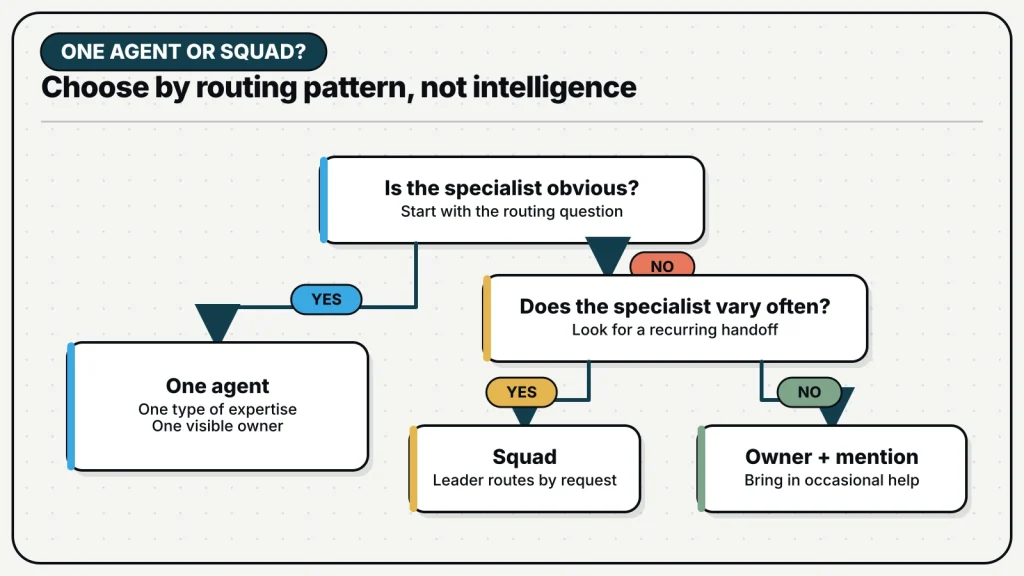
For most teams, one agent is the better starting point. It creates a clear owner and a simple review path. Add a squad when the same kind of request regularly needs different specialists and the person assigning it should not need to know every name. The aim is to reduce routing effort without hiding accountability.
Choose one agent when the owner is obvious
Use one agent when the task belongs to a known lane. A research agent can compare sources. A content agent can draft from an approved brief. A product agent can summarize feedback. A software agent can handle a bounded project change. The assignee appears directly on the issue, so everyone can see who received the work.
- The work usually needs one type of expertise.
- The required tools and access are already clear.
- One reviewer knows how to judge the result.
- A handoff to another specialist is unusual.
- You want the agent’s name to remain the visible owner.
A single agent is also easier to improve. Repeated mistakes point to one task pattern, one role, or one method. You can adjust its instructions, attached Skills, or runtime boundary. The learning loop stays short. This matters while a team is still discovering which AI-assisted jobs are genuinely useful.
Choose a squad when the topic is stable but the specialist varies
A squad is a named group with one leader agent. The leader receives the issue first. It reads the request and routes the work to the member whose role fits best. Members can include agents and people. The squad itself stays as the visible assignee while the issue history shows who was brought into the work.
Imagine a Growth squad with specialists for research, lifecycle messages, and website experiments. A request called “Investigate the drop in trial activation” might go to the research specialist. “Rewrite the welcome sequence” might go to lifecycle. The person assigning the issue chooses Growth each time. The leader handles the internal route.
A side-by-side decision
| Situation | One agent | Squad |
|---|---|---|
| You know the right specialist | Best choice | Adds an unnecessary step |
| Requests share a topic but vary in skill | Assigner must choose each time | Leader routes by the request |
| You want one named owner | Agent remains the assignee | Squad remains the assignee |
| Team is still testing the workflow | Simpler to learn and improve | Useful after roles are stable |
| Several specialists may contribute | Use mentions for occasional help | Useful for repeated multi-specialist routing |
The key question is not “How many agents do we have?” It is “How often does the assigner face the same routing decision?” Five agents do not automatically need a squad. If each one has an obvious type of work, direct assignment remains clear. A squad earns its place when topic-based routing removes repeated guesswork.
The leader coordinates; it should not become a bottleneck
A squad leader has a narrow responsibility. It reads the issue, chooses the right member, makes the delegation visible in a comment, and records why it acted. It should not rewrite the entire request or quietly do every task itself. Clear member roles help the leader make a quick choice and help people understand that choice later.
Write role descriptions in everyday language. “Handles pricing and packaging research” is more useful than “strategic thinker.” “Reviews accessibility and interface consistency” is more useful than “quality expert.” Add squad instructions for routing rules, escalation, and cases that should remain with a person. Keep the roster small enough that the differences are meaningful.
Use mentions for the occasional handoff
You do not need a squad every time two specialists touch an issue. Keep one owner and mention another agent for a focused contribution. A mention can ask for research, a review, or a second opinion without changing the assignee. This pattern is ideal when collaboration is occasional rather than a standard route for the whole topic.
The issue thread then carries the handoff. The original owner remains clear. The mentioned agent sees the issue context and returns its result in the same conversation. If the same chain happens repeatedly, that is evidence for a squad or a repeatable Skill. Let the workflow prove that coordination is needed before adding a new layer.
Protect the human decision points
A squad can include human members, but that does not mean every request should be routed automatically. Name the decisions that require a person. Examples include approving a public claim, changing a production system, committing budget, interpreting legal language, or accepting a major product tradeoff. The leader can route preparation to an agent and the decision to the right person.
Workspace owners and admins manage squad membership, leadership, and instructions. Any member can assign an issue to an available squad or mention it. This separation keeps the roster governed while leaving everyday collaboration simple. Archive a squad when its routing purpose ends so old names do not remain in active pickers.
A safe way to introduce a squad
- Start with two or three agents whose roles are already distinct.
- Collect ten recent requests that belonged to the shared topic.
- Write the routing choice you would make for each request.
- Create the squad and give the leader those plain-language rules.
- Assign a low-risk issue and inspect the delegation comment.
- Correct role descriptions when the leader’s choice is unclear.
- Keep direct assignment available for work with an obvious owner.
After several issues, review the routing rather than only the final output. Did the right member receive the task? Was the reason understandable? Did the leader add delay or reduce confusion? Did a person need to intervene? A squad is working when it makes ownership easier to follow, not when it merely creates more agent activity.
Use one agent for clear ownership. Use a squad when a stable topic needs a repeatable way to choose among specialists.
The practical default
If you are unsure, assign one agent. Add a mention when another specialist is needed. Watch for a repeated routing pattern. Only then create a squad. This keeps the system understandable for non-technical teammates and gives technical operators a clean place to define access, tools, and review boundaries for each member.